Most e-commerce brands should ship in a corrugated box when the product is heavy, fragile, or stacked on a pallet, and in a mailer box when the order is light, flat, and the unboxing moment matters. That is the short answer. The full answer depends on four numbers: product weight, the drop height in your parcel network, the load your cartons carry in a container, and the dimensional weight your carrier bills you for. This guide compares the two structures against those numbers, and it sits alongside our wider range of shipping packaging.
Key Takeaways
- Which box is stronger? A double-wall corrugated box, by a wide margin. Mailer boxes are single-wall die-cut structures and are not designed for pallet loads.
- Which is cheaper to ship? Usually the mailer box, because its profile is smaller and dimensional weight is lower.
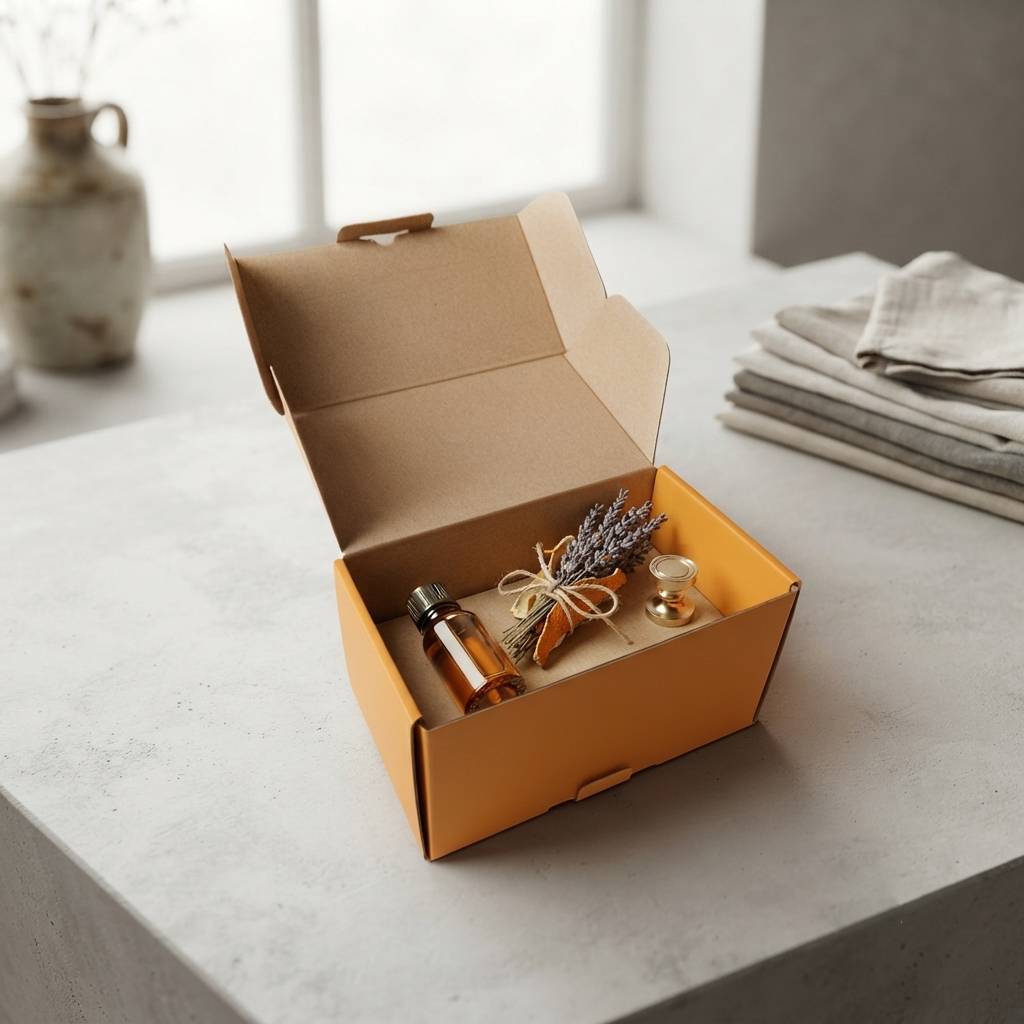
- Which looks better on arrival? The mailer box. A folded, glue-free structure reads as a gift; a standard RSC carton reads as logistics.
- What decides failure in transit? Compression, calculated wet and stacked — not the dry crush figure printed on a spec sheet.
- What should you send for a quotation? Product size and weight, drop height, units per carton, pallet plan, and destination port.
Corrugated Boxes vs Mailer Boxes: The Core Differences
A corrugated box is built for load. Flutes are glued between two liners to create a rigid panel, and the standard regular slotted container (RSC) is designed to be stacked, taped and palletised. A mailer box is built for the moment of opening: a one-piece die-cut sheet that folds into a shallow tray with a lid, usually in E-flute so it stays crisp and flat.
| Factor |
Corrugated box (RSC) |
Mailer box |
| Structure |
Single, double or triple wall, glued flutes |
One-piece die-cut sheet, E-flute or similar |
| Compression strength |
High; carries pallet loads |
Moderate; suited to single parcels |
| Best product profile |
Heavy, fragile, multi-item |
Light, flat, single-item |
| Cushioning |
Needs inserts or void fill |
Folded walls give some built-in protection |
| Storage before packing |
Ships flat, assembled on line |
Ships flat, assembled in seconds |
| Printing |
Flexo, digital, litho-laminated |
Flexo, digital, full-bleed litho |
| Unboxing |
Functional |
Branded, premium |
| Recycling |
Paper-based, widely accepted |
Paper-based, widely accepted |
If your product line is retail-facing and light, our custom mailer boxes are usually the better starting point; if it is export-facing and heavy, start with the carton.

Strength Specs: ECT Grades, Stacking and Drop Tests
Compression strength is quoted as an Edge Crush Test (ECT) value, and in North America it is also expressed as a Box Compression Test (BCT) figure in pounds. ECT describes the board; BCT describes the finished box, which is why two cartons with the same board grade can perform differently once they are scored, vented and printed.
Design practice, in order of importance:
- Calculate the load, then apply a safety factor. A pallet column is a stack, so the bottom carton carries every carton above it. A safety factor of roughly 3 to 5 against the calculated load is common practice, and it rises with humidity, transit time and handling damage.
- Assume strength loss in the cold chain and in humid climates. Untreated board loses a large share of its compression strength as it takes on moisture; wet stacking, not dry strength, is what breaks export pallets.
- Test the way the box travels. A single-box bench test tells you little. A compression test on a full-height stack, after conditioning, is what predicts performance.
- Drop test at the height your network produces. Parcel carriers commonly design to drops in the 30–48 inch range (about 76–122 cm), and small parcels fall more often than heavy ones.
Sizes and Dimensional Weight: Where Freight Costs Hide
Once a parcel crosses a size threshold, carriers charge the greater of actual weight and dimensional weight. Dimensional weight is volume divided by a divisor: roughly 139 in³/lb for US domestic pricing and 5,000 cm³/kg for the metric equivalent. A carton that is 2 inches oversized in every direction can move your shipment into a higher billing bracket without adding a gram of product.
Three practical levers:
- Right-size the box to the product plus its protection, not to the nearest stock size.
- Trim height first. Height is usually the cheapest dimension to remove and the easiest to over-specify.
- Check internal dimensions before production, because liner thickness reduces usable space. Our guide to reading box dimensions covers the internal-versus-external trap in detail.
Inner Protection: Inserts, Pulp Trays and Honeycomb Pads
A box is a frame; the insert is what stops the product moving inside it. Movement is the mechanism behind most cosmetic and structural damage, so the insert matters more than the wall thickness in many programmes.
- Moulded pulp trays. Recyclable, good for bottles, jars and produce; tooling is required and geometry is fixed once cut.
- Corrugated or honeycomb inserts. Lowest tooling cost, easy to change, good for boxed products and electronics.
- EVA or foam inserts. Best retention and premium feel; heavier, and a recycling problem in some markets.
- Paper void fill and air pillows. Fast to use, but they settle. Leave as little empty volume as possible.
Printing and Moisture Resistance for Export
Flexo printing is the workhorse for shipping cartons: one to three colours, low cost, forgiving on kraft board. Digital printing removes the plate cost and makes short runs and versioned SKUs practical. Litho-laminated covers give photographic print quality on heavier board.
Moisture is the other export variable. Container condensation, pre-cooling and humid warehouses all push water into paperboard, and water is what ends stacking strength. If your shipment travels in a reefer, sits in a humid port, or is packed with any free water, specify the moisture route explicitly — the difference between a coated liner and an impregnated board decides whether the bottom layer survives. We cover the specifications and test methods in our guide to wax coated and moisture-resistant corrugated cartons.
Sealing is the last step, and it is where tamper evidence is won or lost. A printed tamper-evident tape shows a void message if the carton is opened, which matters for high-value parcels and for any programme that has to prove a shipment was not interfered with in transit.
Which Should You Choose?
- Subscription and D2C boxes, apparel, accessories: mailer box. Light, flat-packed, brand-forward.
- Electronics, glassware, cosmetics sets: corrugated box with a fitted insert. Protection is the constraint, not the unboxing.
- Multi-item orders: corrugated box. Varying product shapes need a fixed outer frame and internal dividers.
- Fresh produce, flowers, chilled seafood: corrugated box with ventilation and moisture treatment — treated as one specification, never two.
- Large or heavy items over about 20 kg: double-wall corrugated, sized to the pallet footprint, with a tested stack height.
FAQ
Which is stronger, a corrugated box or a mailer box? A corrugated box, particularly double wall. A mailer box is a single-wall die-cut structure and is not designed to carry stacked loads.
Can I ship fragile products in a mailer box? Yes, if the product is light and the folded walls are supported by a fitted insert. For glass, ceramics and anything with a high drop risk, the corrugated box is the safer route.
How do I avoid dimensional weight surcharges? Size the box to the product plus protection, trim height first, and re-measure internal dimensions before production. Even 1–2 inches of unnecessary length in each direction can change the billing bracket.
Are both boxes recyclable? Both are paper-based, and both can carry wax or plastic-free coatings that complicate or simplify recycling. Confirm the coating route with your supplier before you make a recyclability claim.
What is the minimum order and lead time? Custom runs in this category commonly start in the hundreds of pieces, with sampling in one to two weeks and production following sample approval. Confirm the figures that apply to your order rather than relying on a general range.
Ready to Protect Your Shipments? Get a Box Recommendation
Send us your product size and weight, the drop height your network produces, units per carton, your pallet plan and destination port. We will come back with a structure, board grade, insert and print recommendation quoted as one specification.
Talk to the PackTaki team
 English
 Français
 Español