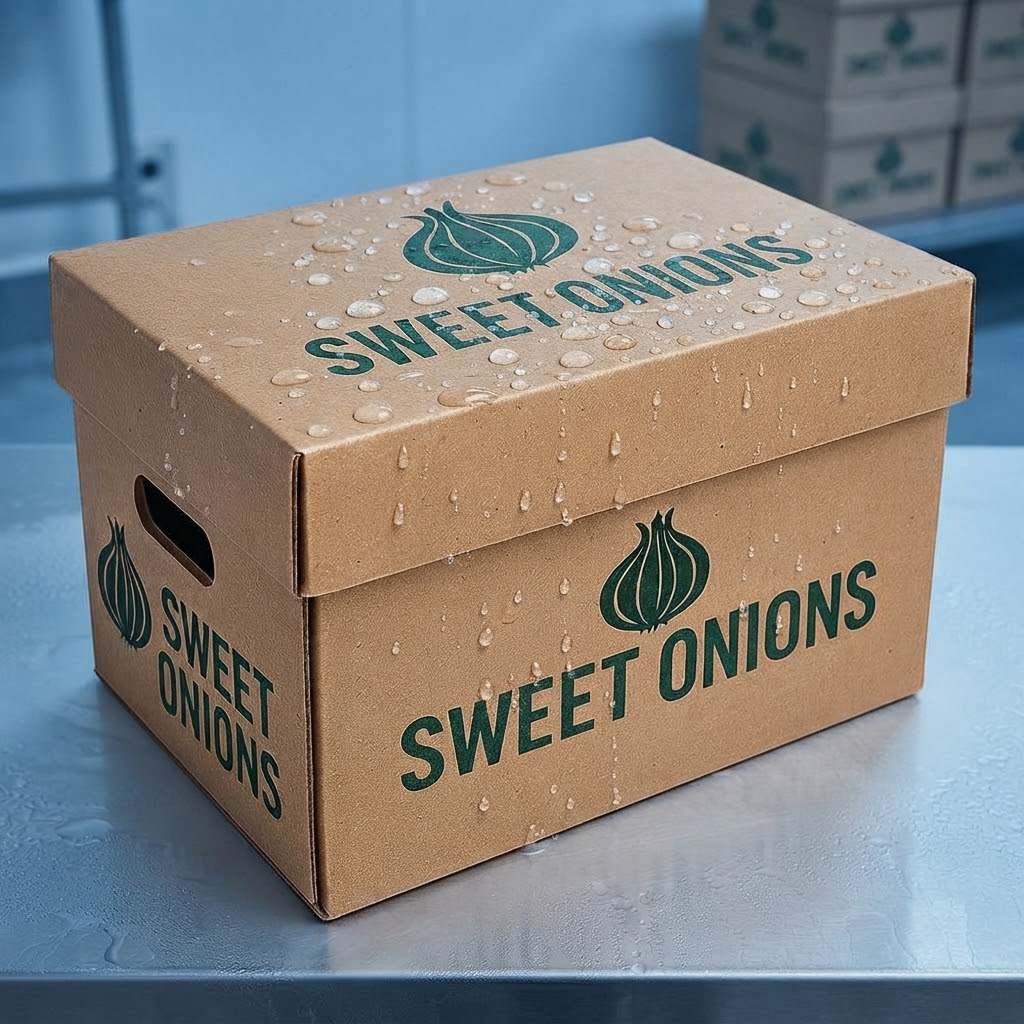
A wax coated corrugated carton is a corrugated box whose liner or board is treated with wax so that it keeps its shape when it gets wet. That single property decides whether a pallet of vegetables arrives saleable after a cold, humid, ice-packed journey. Ice melt in top-ice packs, condensation during pre-cooling, and weeks of reefer humidity all attack paperboard the same way: water breaks the fibre bonds, and broken fibre bonds take stacking strength with them. This guide explains how wax coating and wax impregnation work, what to put in a specification, and how to match the board to each crop, it sits alongside our wider range of fresh produce packaging.
Key Takeaways
- Wax coating puts a moisture barrier on the liner; wax impregnation saturates the board. Impregnated board tolerates far more water, costs more, and is harder to recycle.
- Design to wet strength, not dry strength. Cooling, ice packing, and container humidity can strip a large share of compression strength from an untreated box.
- "Waterproof" is not a specification. Ask for the immersion duration and the test result instead.
- Ventilation and moisture protection pull in opposite directions — specify them together or the carton works against itself.
- Match the carton type to the crop: leafy greens, root vegetables, onions, flowers, and chilled seafood load a carton in very different ways.
What Is a Wax Coated Corrugated Carton?
A wax coated corrugated carton is a corrugated box with a wax layer applied to the inner liner, the outer liner, or both. The board underneath is ordinary corrugated; the wax is what keeps water away from the fibre.
Coating is applied by cascade or curtain coating, roller coating, or a wax bath on the liner before the board is combined. Typical coating weights sit in the range of roughly 8–20 g/m² per treated face, depending on the wax blend and the equipment. Paraffin blends are the traditional choice; microcrystalline and vegetable-based waxes are used where a food-contact or disposal story matters.
Wax impregnation is a different process. Instead of sitting on the surface, the wax is driven into the board, so the fibres themselves become water-repellent rather than shielded. Saturated grades are usually quoted as a wax pick-up percentage of finished board weight. Impregnation survives abrasion, folding, and long immersion far better than a surface coating, which is why it is common for ice-packed and frozen applications.
Two practical consequences follow. First, a coated carton protects the faces; it does not protect cut edges or score lines, and those are exactly where water enters first. Second, wax changes how the box folds and prints, so the design decisions have to be made before artwork is finalised.
Why Water Resistance Decides Vegetable Export Success
Vegetables reach a carton wet in three different ways, and each one attacks the box at a different moment.
The first is ice. Top-ice and ice-slurry packing is still standard for leafy greens, herbs, and bunched vegetables. Meltwater sits in the bottom of the carton and travels down through the stack, so the boxes that carry the most weight are also the wettest.
The second is condensation. Warm produce packed and then cooled releases moisture, and that moisture condenses on the coldest surface available — usually the container wall and the outer face of the outer cartons. Swing between ambient and chilled conditions makes it worse, not better.
The third is process water. Post-harvest washing, hydrocooling, and sanitising leave free water on the produce and inside the pack.
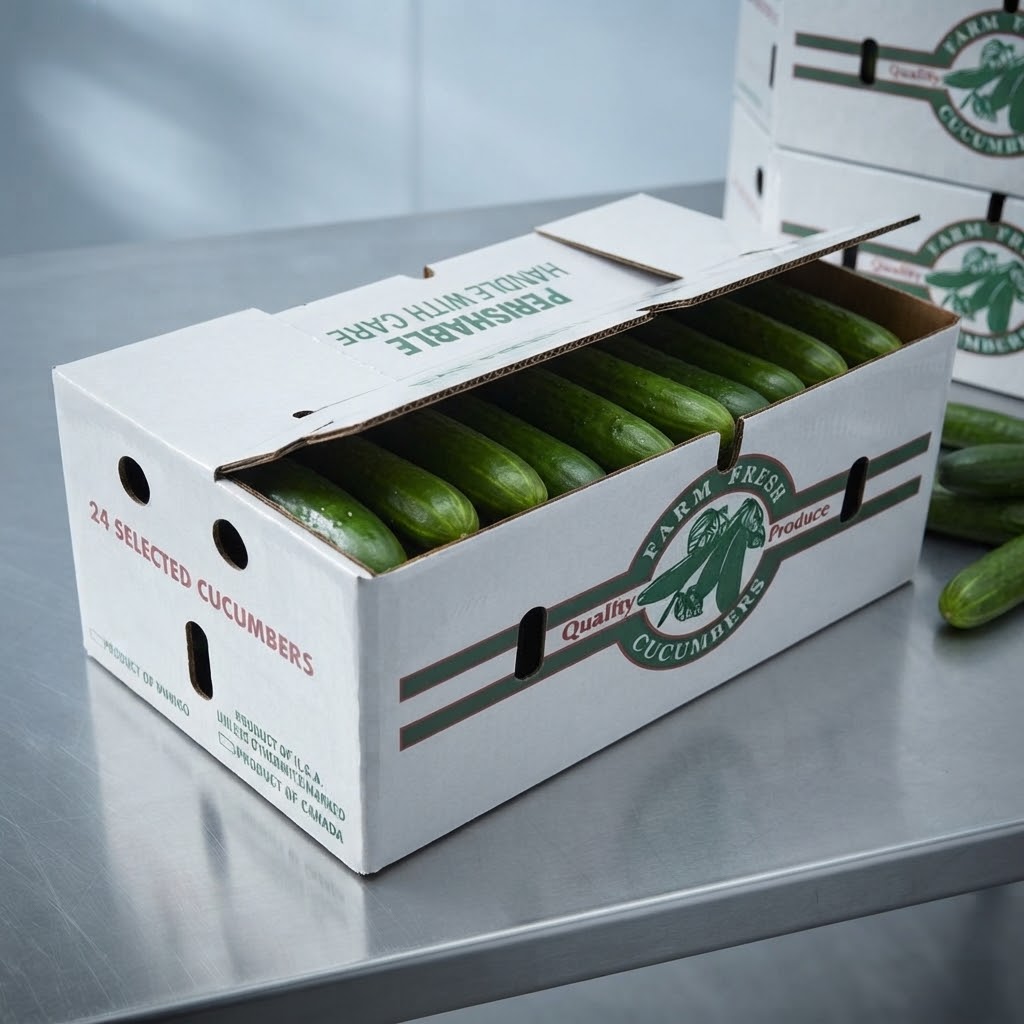
Untreated paperboard absorbs water quickly and loses compression strength as it does. A carton specified only on its dry compression value can pass a stacking test in the warehouse and still collapse three weeks into a sea voyage. This is the single most common specification gap we see in vegetable export programmes, and it is the same failure mode covered in our guide to choosing ventilation and stacking strength for export cartons.
Ice-Water Resistance: What the Test Actually Measures
"Waterproof" and "water resistant" get used interchangeably in quotations, but they describe very different performance. A wax coated carton is water resistant: it limits water uptake and holds its structure for a defined period. It is not a waterproof vessel.
A practical acceptance test is immersion in an ice-water slurry. The carton, or a board sample, is submerged for a defined time — 30 to 60 minutes is a common working range, and buyers with longer cold chains sometimes extend it to 24 hours — then checked for three things:
- Liner separation. If the inner and outer liners have started to lift away from the flutes, the box has failed even though it still looks intact.
- Handling strength. Does the carton still carry its rated load without bulging at the base?
- Board swell. Excessive thickness gain signals that the wax layer is not doing its job.
Water absorption itself is usually measured with a Cobb-type test, which reports how much water a defined area of board absorbs in a set time. Compression strength is measured dry and after conditioning, which is what turns a marketing claim into an engineering comparison.
The number that matters for procurement is not the word on the spec sheet but the pair of values behind it: immersion time and post-immersion performance. Ask for both, and ask for the test method used.
Wet Strength: How Wax Keeps Pallets Stable in the Cold Chain
Stacking strength is what stops a pallet from settling, leaning, and crushing the bottom layer. In vegetable export it is almost never dry strength that governs, because the bottom cartons are the ones exposed to meltwater and the longest period of compression.
Industry figures vary with board grade and test method, but the pattern is consistent: untreated corrugated board can lose a large fraction of its compression strength once it is wet, while wax-treated board commonly retains the majority of its dry value after short-term exposure. Treat any specific percentage as an indication to be verified on your own board, not as a guarantee.
Three levers control the outcome:
- Board grade and flute. Higher ECT values buy more wet strength, and double-wall constructions absorb the loss better than single wall.
- Wax coverage. Between-flute protection, not just face protection, is what keeps a wet box from collapsing. Impregnation closes that gap.
- Stack design. A carton that overhangs the pallet puts the load on its weakest face. Wet strength cannot fix a bad pallet pattern.
As a design habit, specify the stack height you actually plan and test at that load after a humidity exposure, rather than testing a single box on a bench. A 24-hour conditioning test on a full-height stack tells you more than any dry compression figure.
Wax Coated vs Wax Impregnated vs Waterproof Coated Cartons
| |
Wax coated |
Wax impregnated |
Water-based moisture barrier |
| How it works |
Wax film on the treated liner |
Wax driven into the board fibres |
Recyclable coating on the liner |
| Water resistance |
Good for splash, meltwater, and condensation |
Highest — survives soaking and abrasion |
Moderate; best for humidity rather than standing water |
| Wet stacking strength |
Good |
Best in the group |
Good, slightly below wax impregnation |
| Recyclability |
Limited — wax complicates repulping |
Limited |
Best — designed for standard repulping |
| Relative cost |
Moderate |
Highest |
Moderate |
| Best for |
Chilled vegetables, top-ice packs, reefer export |
Ice slurry, frozen and thawed cycles, long immersion |
Retail programmes with recycling commitments |
Wax coating and wax impregnation buy wet performance with a recycling trade-off: wax is difficult to remove in a standard pulping line, so waxed cartons are often excluded from kerbside collection. Water-based barrier coatings give up some water resistance to keep the carton in the recycling stream. The right answer depends on which constraint your buyer or your market actually enforces.
Matching the Carton to Your Produce
The board is only half the specification. How the crop loads the box decides the rest.
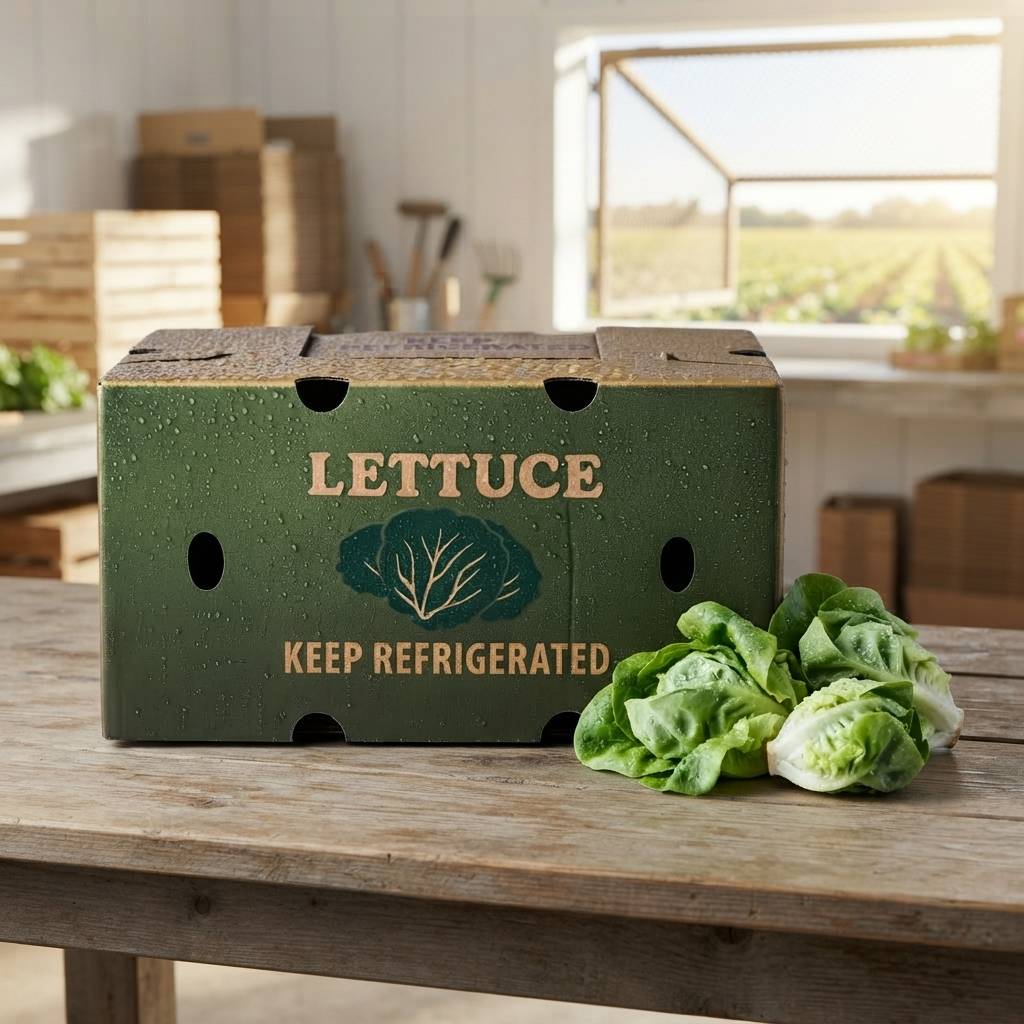
Leafy greens and fresh herbs. Ice-packed, high respiration, short cycle. These need ventilation for cooling and moisture protection at the same time, so wax coated single wall with aligned vents is usually the compromise. Keep the produce below the rim so it does not press against the lid.
Root vegetables and potatoes. Heavy, abrasive, often packed with residual soil moisture. Compression is the dominant load, so a stronger board with an impregnated liner pays for itself. Watch the bottom corners, where stacking failures start.
Onions and alliums. Cured onions travel in drier conditions but still meet condensation. They need generous ventilation more than heavy wax, and the carton has to hold a tall, dense load without bulging.
Fresh flowers. Sold by stem count, damaged by water and ethylene. Bucket water, cooling, and humid reefer air make a moisture-resistant liner worthwhile, and bouquet cartons need internal height rather than heavy compression.
Chilled seafood. Treated here as part of the same cold chain: ice slurry is the most aggressive water exposure in the group, and this is where wax impregnation is usually the only specification that holds up.
Whatever the crop, size the carton around the pallet footprint before choosing a board grade — the same logic we cover in our guide to reading box dimensions.
Cold Chain Export Scenarios: Pre-Cooling, Ice Packing & Reefer
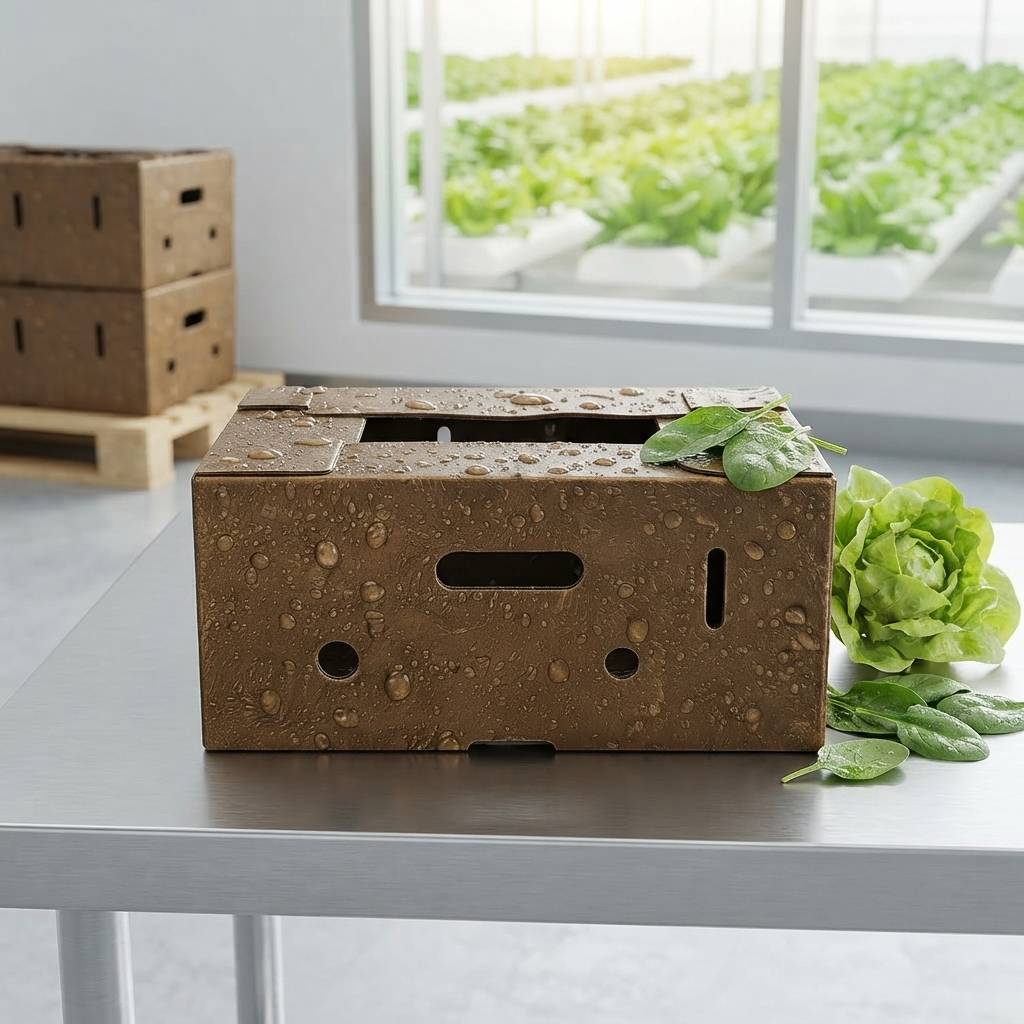
Forced-air pre-cooling. Air is pushed through the pallet, so the ventilation pattern has to align with the airflow direction. Cartons that vent only on one face lose cooling time and develop condensation on the unvented faces.
Top-ice and ice-slurry packing. Water sits in the pack for the whole transit. Choose impregnated board, keep a small clearance between produce and carton wall, and expect the base of the pallet to be the wettest zone.
Reefer containers. Condensation collects on the coldest surfaces and cycles as the container defrosts. A moisture-resistant liner on the outer face reduces uptake, and cartons should not sit flush against the container wall.
Air freight. Short exposure, high value, low tolerance for damage. Light single wall with a coated liner is usually enough, and the weight saving matters more than the wax pick-up.
Printing, Branding and Moisture: What Wax Does to Print
Wax and ink compete for the same surface, and wax usually wins. A treated liner has low surface energy, so ink adhesion is weaker and print definition drops.
Three workable approaches:
- Pre-print the liner, then wax. Best print quality, standard in branded programmes.
- Use wax-compatible inks and coatings. Minimum disruption to the production flow, slightly lower print durability.
- Print on an untreated panel. Keep the treated area to the surfaces that meet water and leave one face clean for artwork.
Whichever route you take, keep compliance information, origin, variety, grade, net weight, lot code on a clean, high-contrast panel, and reserve space for grower or shipper labels so they do not cover essential text. Food-safe inks and coatings are non-negotiable in any area that touches produce. Print durability in a wet pack is worth testing on a sample before a full run.
Specifications & What to Send for a Quote
| Item |
Typical working range (confirm for your order) |
| Board and flute |
Single wall C-flute for standard packs; BC double wall for high stacking or long sea transit |
| Wax treatment |
Coated inner and/or outer liner; impregnated grades for ice slurry and frozen cycles |
| Coating weight |
Roughly 8–20 g/m² per treated face for coating; impregnation quoted as wax pick-up |
| Water resistance |
Defined immersion time plus liner-separation and handling criteria |
| Wet stacking strength |
Wet-to-dry retention tested at your planned stack height |
| Size |
Internal dimensions for product fit, external dimensions for freight |
| Ventilation |
Open area percentage aligned with cooling direction and pallet pattern |
| Printing |
Flexo, pre-printed liner, or wax-compatible inks |
| MOQ |
500 pcs |
| Lead time |
Sample in 10-15 days, production after sample approval |
| Compliance |
Food-contact inks, chain-of-custody certification where required, transit testing on request |
| PackTaki Test Standard |
Wet Edge Crush Test (Wet ECT) in accordance with TAPPI T836 / ISO 3037 standards. |
To quote quickly we need: carton internal size, pack weight, number of cartons per pallet and per stack, crop and packing method, cooling route, print artwork, and target port. Send those and you get board grade, wax treatment, ventilation, print, and pallet loading quoted together. If this is your first order, our walkthrough of how to place a custom packaging order covers the artwork and sample approval steps. Buyers sourcing produce cartons more broadly will also find useful context in our fruit cartons range.
FAQ
Are wax coated cartons waterproof?
No. They are water resistant. A wax coating limits water uptake and holds structure for a defined immersion time. Genuine waterproofing requires a liner or a plastic barrier, which changes the recycling profile.
Will wax transfer onto the vegetables?
A properly applied and cured coating should not transfer under normal cold chain conditions. Confirm food-contact suitability and cure time with your supplier, and keep produce from sitting directly on a heavily coated base for long periods.
How much wet stacking strength do I lose in the cold chain?
It depends on board grade, wax treatment, and how long the cartons stay wet. Rather than accepting a general figure, test your board dry and after conditioning, and design the pallet height on the conditioned value.
Can wax coated cartons be recycled?
Wax complicates repulping, so waxed cartons are often excluded from standard recycling streams. If recycling is a hard requirement, a water-based barrier coating is the better starting point.
What is the difference between wax coated and wax impregnated?
Coating puts a wax film on the liner surface. Impregnation drives wax into the board so the fibres themselves resist water. Impregnation performs better under soaking, abrasion, and folding, and costs more.
Do wax coated cartons still need ventilation?
Yes. Moisture protection and ventilation are separate jobs. Vegetables still need airflow for cooling and respiration; without vents, the carton protects the board but not the produce.
Can we print our brand on wax coated cartons?
Yes, with the right sequence. Pre-printing the liner before waxing gives the best print quality; wax-compatible inks are the alternative when the liner is treated first.
PACKTAKI manufactures export-grade wax coated and wax impregnated corrugated cartons for vegetables, chilled seafood, and fresh flowers. Send your carton size, pack weight, pallet plan, packing method, and destination port, and we will quote board grade, wax treatment, ventilation, print, and pallet loading as one specification. Chat with Packtaki Team!
 English
 Français
 Español